
NEET Inorganic Chemistry – Complete Strategy Guide for 2026
NEET Inorganic Chemistry plays a decisive role in overall NEET Chemistry scores. For many aspirants, this section feels memory-heavy and unpredictable. However, with structured understanding and logical grouping, NEET Inorganic Chemistry becomes one of the most scoring parts of the exam.
This complete strategy guide is designed for serious NEET-UG aspirants preparing for 2026 who want clarity, stability, and a systematic preparation roadmap.
Instead of memorizing reactions randomly, this guide explains how to structure the entire Inorganic syllabus — from Periodic Table logic to Block Chemistry and Coordination Compounds — in a way that improves retention and reduces exam anxiety.
Why NEET Inorganic Chemistry Feels Difficult for Many Aspirants
NEET Inorganic Chemistry does not become difficult because the concepts are impossible. It becomes difficult because the structure of learning is often fragmented.
Many students prepare the syllabus chapter by chapter without connecting underlying trends. For example, Periodic Table logic for NEET is studied separately from Block Chemistry. Chemical Bonding fundamentals are memorized for theory but not applied while understanding reaction behavior.
As a result:
Reaction patterns are not grouped logically.
Oxidation states are remembered without structural mapping.
Coordination Compounds appear complex instead of systematic.
NCERT lines are read but not decoded for pattern recognition.
Over time, this creates the illusion that Inorganic Chemistry for NEET 2026 is purely memory-based.
In reality, when trends, bonding logic, and reaction families are integrated into one structured framework, the subject becomes predictable.
Predictability reduces anxiety.
Structure improves retention.
Clarity increases scoring consistency.
Complete Syllabus Breakdown for NEET Inorganic Chemistry
To master NEET Inorganic Chemistry, aspirants must understand how different chapters connect structurally. Below is a strategic breakdown of the major areas and how they should be approached during preparation.
Periodic Table and Chemical Bonding Foundation
Periodic Table logic for NEET forms the structural base of Inorganic understanding. Trend analysis, atomic size variation, ionization energy patterns, and electronegativity relationships must be studied conceptually rather than memorized.
Chemical Bonding fundamentals for Inorganic Chemistry directly influence reaction behavior, hybridization trends, and structure-property relationships. Without bonding clarity, higher-level chapters remain unstable.
s-Block and p-Block Elements Strategy
Block Chemistry for NEET requires reaction grouping rather than isolated memorization. Instead of learning each compound separately, students should map reaction families such as oxides, halides, hydrides, and oxyacids based on trends and oxidation states.
This structured approach reduces memory load significantly.
d and f Block Elements
Transition elements introduce variable oxidation states and coordination behavior. Understanding electronic configuration and stability trends makes d and f Block Chemistry systematic rather than overwhelming.
Pattern-based preparation improves predictability in exam conditions.
Coordination Compounds for NEET
Coordination Compounds for NEET must be approached logically through Crystal Field Theory, ligand strength order, and geometry prediction patterns. When ligand behavior is understood structurally, questions become formula-driven instead of guess-based.
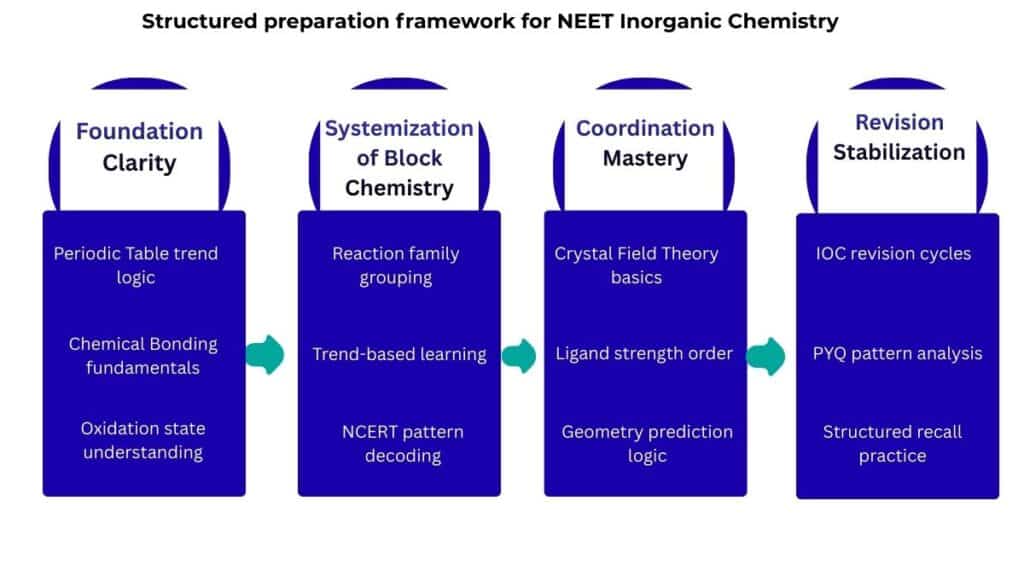
Structured Preparation Framework for NEET Inorganic Chemistry
A systematic approach transforms NEET Inorganic Chemistry from a memory-heavy subject into a pattern-based scoring section. The preparation framework must move through defined phases instead of random chapter completion.
Phase 1 – Foundation Clarity
Periodic Table logic for NEET forms the structural base of Inorganic understanding. Trend analysis, atomic size variation, ionization energy patterns, and electronegativity relationships must be studied conceptually rather than memorized.
Chemical Bonding fundamentals for Inorganic Chemistry directly influence reaction behavior, hybridization trends, and structure-property relationships. Without bonding clarity, higher-level chapters remain unstable.
Phase 2 – Systemization of Block Chemistry
Approach Block Chemistry for NEET by grouping reactions into structural families. Map oxidation states, common reaction types, and recurring NCERT patterns. Structured grouping significantly reduces revision time later.
Phase 3 – Coordination Mastery
Coordination Compounds for NEET require formula-driven clarity. Focus on Crystal Field Theory trends, geometry prediction, and ligand strength order. Once structural logic is understood, complex questions become systematic.
Phase 4 – Revision Stabilization
Design an IOC revision strategy that integrates PYQ analysis, trend mapping, and periodic consolidation. Repeated exposure to structured patterns reduces NEET exam anxiety and improves scoring consistency.
How to Score 160+ in NEET Chemistry with Strong Inorganic Foundation
Scoring 160+ in NEET Chemistry requires balance across Physical, Organic, and Inorganic sections. However, NEET Inorganic Chemistry offers one of the most stable scoring opportunities when prepared systematically.
While Organic Chemistry may fluctuate due to interpretation-based questions, Inorganic becomes predictable when trends and patterns are structured clearly.
- Master Periodic Table trend patterns
- Group Block Chemistry reactions logically
- Practice Coordination Compounds through formula-based clarity
- Integrate PYQ pattern analysis weekly
- Avoid last-minute reaction cramming
- Stabilize revision cycles 60 days before exam
When NEET Inorganic Chemistry becomes predictable, it reduces risk in overall Chemistry scoring. Stability in one section creates psychological confidence across the paper.
Structured preparation always outperforms rushed memorization.
Common Mistakes Students Make in NEET Inorganic Chemistry
Even sincere aspirants struggle with NEET Inorganic Chemistry because of avoidable strategic mistakes. Identifying these errors early can significantly improve scoring consistency.
- Memorizing reactions without understanding trend logic
- Ignoring Periodic Table pattern relationships
- Studying Chemical Bonding separately but not applying it in Inorganic chapters
- Solving PYQs without analyzing recurring question patterns
- Leaving Coordination Compounds for the end of preparation
- Doing last-minute cramming instead of structured revision cycles
Most difficulties in NEET Inorganic Chemistry are not due to subject complexity but due to preparation structure. Correcting approach often improves results faster than increasing study hours.
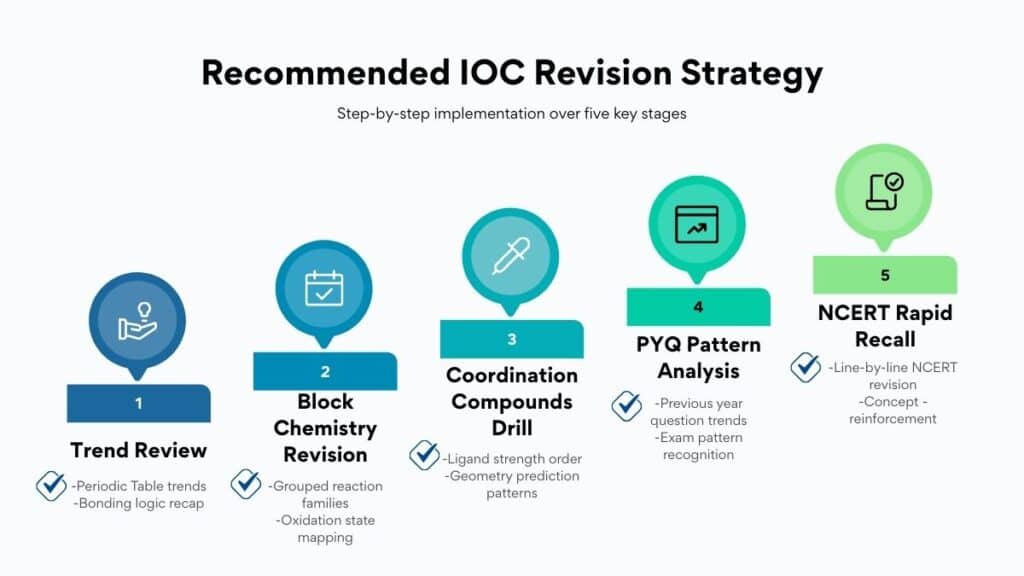
Recommended IOC Revision Strategy for NEET 2026
Revision determines whether NEET Inorganic Chemistry remains unstable or becomes predictable. A structured IOC revision strategy must move beyond random reaction repetition and focus on pattern consolidation.
- Weekly trend revision from Periodic Table logic
- Group-wise Block Chemistry consolidation
- Coordination Compounds formula drill sessions
- Oxidation state pattern mapping
- NCERT line-based rapid recall cycles
- PYQ-based structured revision every 10–15 days
Instead of reading the entire Inorganic section repeatedly, aspirants should revise by structural clusters. This approach reduces cognitive overload and improves retention speed. When revision is structured, NEET exam anxiety decreases significantly.
Consistency in structured revision cycles is more powerful than last-minute memorization.
Frequently Asked Questions About NEET Inorganic Chemistry
Is NEET Inorganic Chemistry purely memory-based?
No. NEET Inorganic Chemistry feels memory-heavy only when trend logic and reaction grouping are not structured properly. When Periodic Table patterns and Chemical Bonding fundamentals are applied consistently, the subject becomes systematic rather than memorization-driven.
How many questions come from Inorganic in NEET?
The Inorganic section of NEET typically contributes a significant portion of Chemistry questions. While distribution may vary slightly each year, structured preparation ensures stable scoring from this segment.
What is the best strategy to master Block Chemistry for NEET?
Block Chemistry for NEET should be prepared by grouping reactions into families based on oxidation states and trend behavior. NCERT-based mapping and repeated pattern revision improve retention significantly.
How should I revise Coordination Compounds before NEET?
Coordination Compounds for NEET should be revised using formula-based recall. Focus on ligand strength order, geometry prediction, Crystal Field Theory basics, and recurring PYQ patterns.
Can I score 160+ in NEET Chemistry if Inorganic is weak?
Yes, but stability in NEET Inorganic Chemistry reduces overall risk. Since this section becomes predictable when structured, strengthening it improves total Chemistry performance consistency.
Need Structured Guidance in NEET Inorganic Chemistry?
If you prefer guided clarity instead of self-trial and error, structured mentorship can significantly
reduce preparation instability.
You may explore structured sessions designed specifically for NEET Inorganic Chemistry aspirants.
Understand clearly. Then decide calmly.
Go to -> neet 2026 Official website