
Remember inorganic chemistry for NEET becomes much easier when the subject is studied through structured patterns rather than random memorization. Many NEET aspirants feel that remembering reactions, trends, and exceptions in inorganic chemistry is overwhelming. The difficulty usually arises not because the subject itself is impossible, but because it is often approached without a clear conceptual framework.
When reactions and concepts are memorized randomly, the brain treats them as isolated pieces of information. Over time this leads to confusion during revision and increases exam pressure, especially when students try to recall multiple reactions and trends in a short time.
However, when students understand how to remember inorganic chemistry for NEET through chemical bonding patterns, reaction families, and periodic trends, the subject becomes far more logical and predictable. Instead of memorizing every reaction individually, learners begin to recognize repeating patterns that connect different chapters of inorganic chemistry.
This pattern-based approach improves retention, reduces revision stress, and helps students solve unfamiliar questions in the exam. If you want a deeper roadmap for mastering IOC, explore the complete NEET Inorganic Chemistry strategy guide.
If you want a deeper roadmap for mastering IOC, explore the complete NEET Inorganic Chemistry strategy guide.
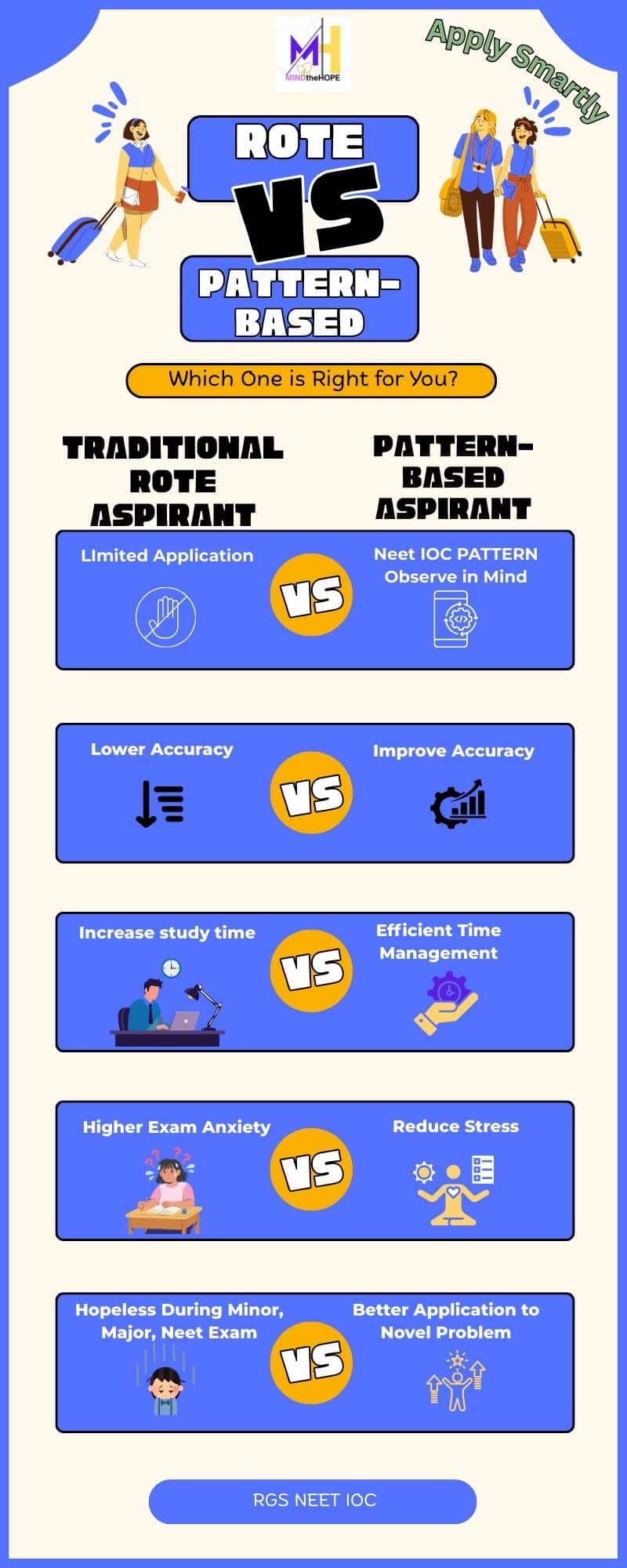
Why Students Struggle to Remember Inorganic Chemistry for NEET
Students often struggle to remember inorganic chemistry for NEET because they try to memorize reactions individually without understanding periodic trends and bonding patterns.
Common reasons include:
• Random memorization
• Ignoring periodic trends
• Lack of revision cycles
• Not grouping reactions logically
How to Remember Inorganic Chemistry for NEET Using Pattern Learning
Instead of memorizing hundreds of reactions individually, group them according to periodic trends and reaction families. Pattern recognition reduces cognitive load and allows the brain to store information more efficiently.
Many reaction patterns become clearer when studying block chemistry for NEET systematically.
Examples of patterns include oxidation state trends, reaction families, and periodic behavior across groups.
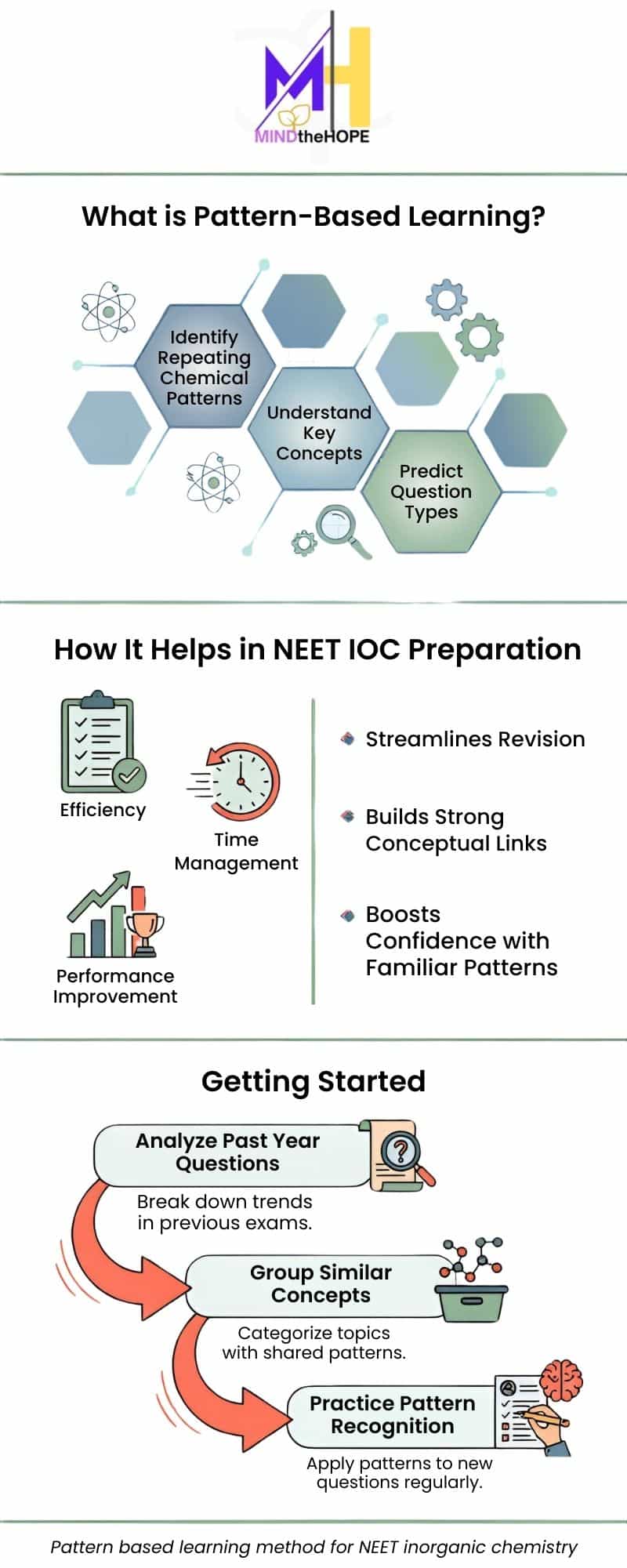
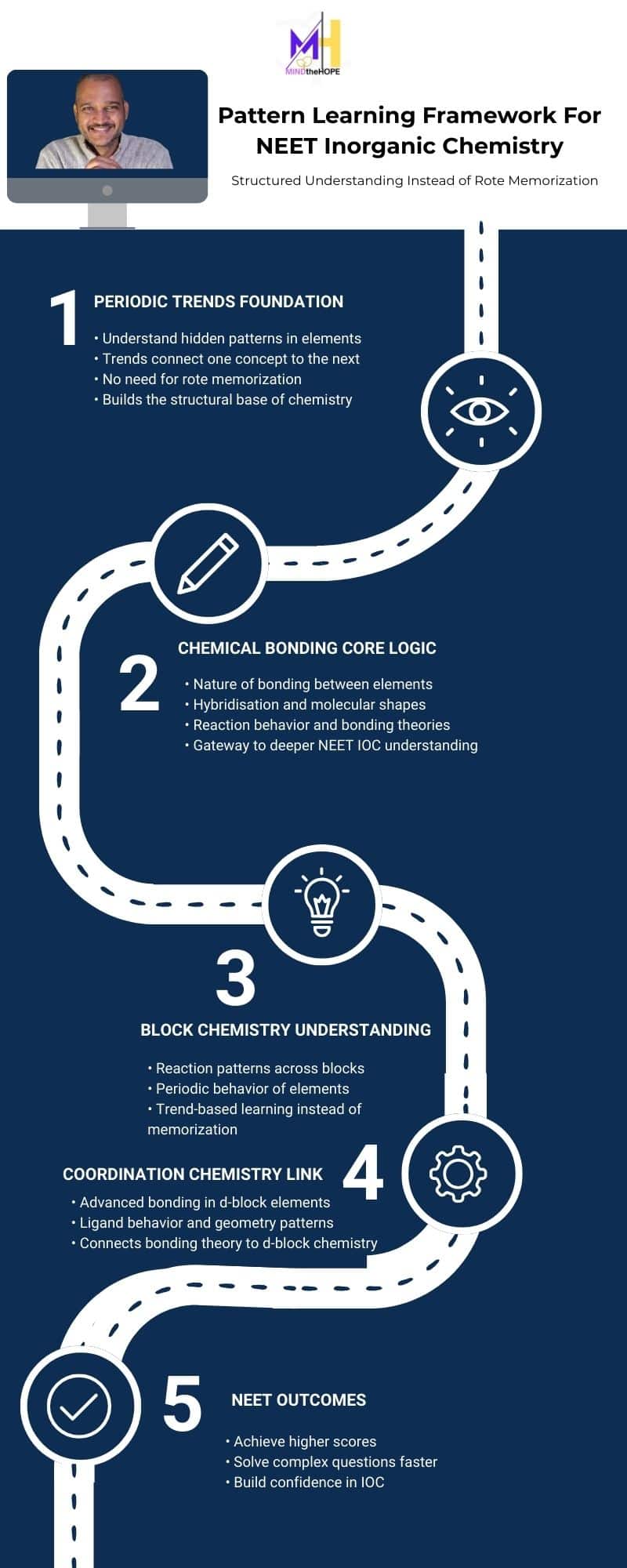
Pattern-based learning framework for remembering inorganic chemistry for NEET.
Reaction Grouping Strategy for NEET Inorganic Chemistry
A practical method for remembering reactions is grouping them by type. Instead of learning each reaction separately, students should study families of reactions such as oxides, halides, hydrides, and oxyacids.
This approach reduces memorization load and improves recall speed during exams.
Students who struggle with memorization can learn how to remember inorganic chemistry reactions through logical reaction families.
Students who want to remember inorganic chemistry for NEET efficiently should group reactions according to periodic trends and reaction families.
Smart Revision Strategy for NEET Inorganic Chemistry
A well-designed NEET inorganic chemistry revision strategy helps reinforce patterns and improve recall before the exam.
- Weekly periodic table revision
- Reaction family grouping
- Coordination compounds formula review
- NCERT line-by-line revision
- Previous year question analysis
Why Pattern Learning Makes NEET Inorganic Chemistry Easier
Students often believe that remembering reactions in inorganic chemistry requires endless memorization. However, when topics are learned through pattern-based connections—such as periodic trends, reaction families, and bonding logic—the subject becomes structured. Instead of memorizing isolated facts, students begin to recognize repeating chemical patterns. This approach reduces cognitive overload and allows faster recall during exams.
According to the NCERT Chemistry curriculum, conceptual clarity helps students retain inorganic chemistry concepts more effectively.
Bullet points:
- Reaction families become easier to remember
- Revision becomes faster before NEET
- Students recognize question patterns quickly
- Conceptual confidence improves significantly
Key Concepts Connected to Inorganic Chemistry for NEET
- Periodic trends and periodic table logic
- Chemical bonding fundamentals
- • Block chemistry patterns in s, p, and d blocks
- Coordination compounds and ligand behavior
- Oxidation states and reaction trends
- NCERT inorganic chemistry lines and exceptions
Final Thoughts on Remembering Inorganic Chemistry for NEET
Remembering Inorganic Chemistry for NEET does not require extraordinary memory. It requires structure, pattern recognition, and consistent revision.
Understanding how to remember inorganic chemistry NEET topics becomes much easier when students focus on patterns rather than isolated reactions. When periodic trends, bonding logic, and reaction families are connected logically, inorganic chemistry becomes predictable instead of overwhelming.
Understanding patterns is one of the most reliable ways to remember inorganic chemistry for NEET without depending only on rote memorization.
When preparation becomes organized, confidence replaces anxiety.
Key Concepts That Help You Remember Inorganic Chemistry for NEET
- Periodic table trends and element behavior
- Chemical bonding patterns and molecular structure
- Reaction families in block chemistry
- Coordination chemistry and ligand interactions
- Oxidation states and reaction predictability
- NCERT-based inorganic chemistry concepts
Understanding these concepts together helps students remember inorganic chemistry for NEET more effectively. When periodic trends, bonding patterns, and reaction families are connected logically, inorganic chemistry becomes structured rather than memory-heavy.